My Work & Impact
Explore a curated collection of my work, showcasing my journey as a dedicated researcher, analyst, and volunteering activist. Each project reflects my commitment to creating positive change and demonstrates my in-depth knowledge in sustainability, analysis, and policymaking. I am a strong student who has in-depth knowledge of my field with a proven track record, dedicated to making a difference.
Project 1: Data-Driven Conservation Planning in Tropical Plantation Landscapes
Background and Relevance
Sri Lanka is a global biodiversity hotspot where approximately 20-30% of the Wet Zone is managed as private estates outside the protected area network. These landscapes contain over 60,000 hectares of natural habitats, which are critical for the survival of threatened and endemic species. This project focused on analyzing the species richness across 25 estates managed by Kelani Valley Plantations PLC (KVPL) to understand how land use and climatic variables influence biodiversity. This work is vital for integrating private lands into national biodiversity accounting and ensuring sustainable land management in a way that balances agricultural production with conservation.
The Skills Involved
- Geospatial Analysis (QGIS): Used for mapping estate distributions and analyzing spatial biodiversity data within the national grid.
- Statistical Analysis & Multivariate Clustering: Applied Principal Component Analysis (PCA) to cluster 25 estates based on 17 distinct variables, including agricultural, land use, and climatic factors.
- Meta-Analysis: Synthesized existing species richness data from a four-year sampling period (2017-2020) to extract meaningful ecological trends.
- Biodiversity Assessment: Utilized National Red Lists to evaluate the threat status and endemicity of various taxa, including mammals, birds, butterflies, and freshwater fish.
My Contribution and Outcome
As the lead researcher, I spearheaded the analysis of species richness data and the identification of key environmental drivers.
- Key Findings: My analysis revealed that KVPL estates harbor significant biodiversity, including 90% of endemic birds and over 50% of threatened amphibians and freshwater fish recorded in Sri Lanka.
- Identification of Drivers: I demonstrated that while forest coverage is vital for sustaining biodiversity, landscapes heavily oriented toward tea production showed the lowest richness for mammals and birds.
- Strategic Impact: The resulting clusters provide a framework for estate management to implement targeted conservation strategies based on the specific ecological profile of each location.
- Dissemination: This research was presented and published in the proceedings of the WILDLANKA International Symposium 2024 and the Forestry Symposium 2025 and also gave key inputs for decision making for the company as demonstrated in their 2023 annual report

Project 2: Pioneering Science-Based Target (SBTi) Validation for the Plantation Sector
Background and Relevance
Corporate accountability is a cornerstone of sustainable societies, yet many organizations struggle to align their operations with the 1.5°C goal of the Paris Agreement. This project was initiated when Kelani Valley Plantations PLC (KVPL) faced the removal of its commitment status due to the complexity of target submission. During my internship, I spearheaded the end-to-end process of setting and validating science-based targets. This was a landmark achievement, making KVPL the first plantation company in Sri Lanka to successfully validate near-term, long-term, and net-zero targets, thereby restoring and elevating its global standing in ESG (Environmental, Social, and Governance) leadership.
The Skills Involved
- ESG & Carbon Accounting: Calculated comprehensive Scope 3 emissions while refining Scope 1 and 2 inventories to ensure strict adherence to the GHG Protocol and SBTi Setting Manual.
- Technical Compliance & Research: Conducted deep-dive analyses of complex regulatory frameworks, including SBTi Criteria, Target Validation Protocols, and specialized FLAG (Forest, Land, and Agriculture) Guidance.
- Data Modeling & Justification: Developed rigorous emission models and drafted technical justifications to address intensive queries from the SBTi validation team over a six-month period.
- Strategic Sustainability Planning: Translated climate science into actionable corporate milestones, aligning long-term business strategy with global net-zero trajectories.
My Contribution and Outcome
I managed the entire six-month validation lifecycle, serving as the technical lead between the company and the SBTi.
- Inventory Refinement: I successfully mapped the value chain to calculate Scope 3 emissions and integrated FLAG-specific requirements, including land-related emissions and removals.
- Milestone Achievement: I led the company to move from a "removed" status to becoming a national industry pioneer with fully validated targets.
- Validated Targets:
- Net-Zero: Committed to reaching net-zero GHG emissions across the value chain by FY2049.
- Near-Term (FY2033): Absolute reduction of 58.8% in Scope 1 & 2 (Energy & Industry) and 42.4% in Scope 1 & 3 FLAG emissions.
- Long-Term (FY2049): Deep decarbonization targets of 90% for Energy & Industry and 72% for FLAG emissions.
- Zero Deforestation: Successfully integrated a commitment to maintain no deforestation across all primary deforestation-linked commodities.


Project 3: Sarubima – Empowering Rural Agripreneurship through Sustainable Bio-Fertilizer Systems
Background and Relevance
In rural Sri Lankan farming communities, reliance on costly synthetic fertilizers often leads to economic instability and environmental degradation. The Sarubima project, located in Hapugasyaya, Matale, was designed to address these challenges by establishing a community-led organic liquid fertilizer (OLF) production system. The goal was to create a circular economy model where farmers could generate an additional income stream while transitioning to greener agricultural practices. This project is highly relevant to sustainable development as it bridges the gap between traditional farming and modern sustainable entrepreneurship through capacity building and institutional collaboration.
The Skills Involved
- Project Design & Strategic Leadership: Spearheaded the project from initial brainstorming and site selection to full-scale implementation over a period of more than a year.
- Grant Acquisition & Financial Management: Successfully pitched the project to secure a 4,000 EUR (approx. 1,500,000 LKR) grant and managed the allocation for equipment, training, and pilot runs.
- Stakeholder Collaboration: Facilitated partnerships between the local community, government agricultural instructors, village officers, and academic institutions like the University of Peradeniya.
- Logistics & Operational Monitoring: Oversaw the procurement and donation of bulk equipment and established a rigorous post-monitoring framework to ensure production quality and sustainability.
My Contribution and Outcome
As the project lead, I was responsible for the end-to-end lifecycle of this initiative, navigating complex logistical challenges to ensure community buy-in.
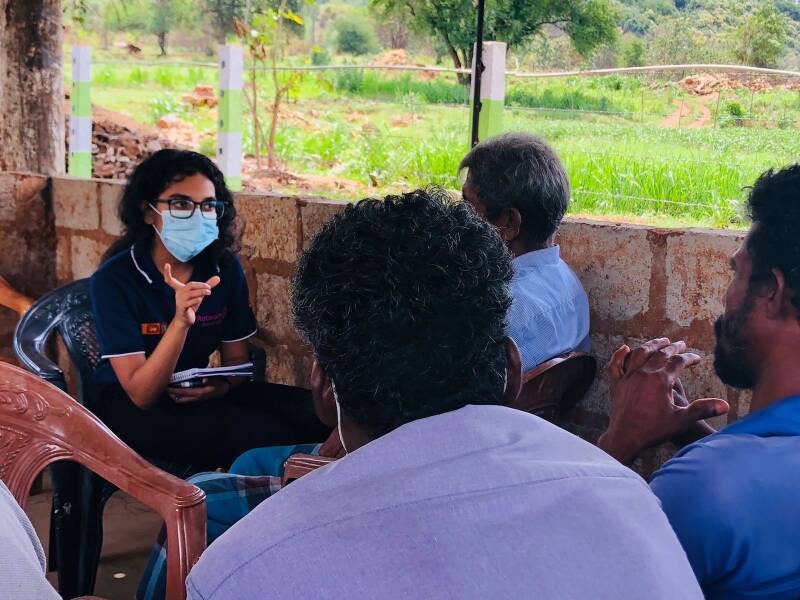
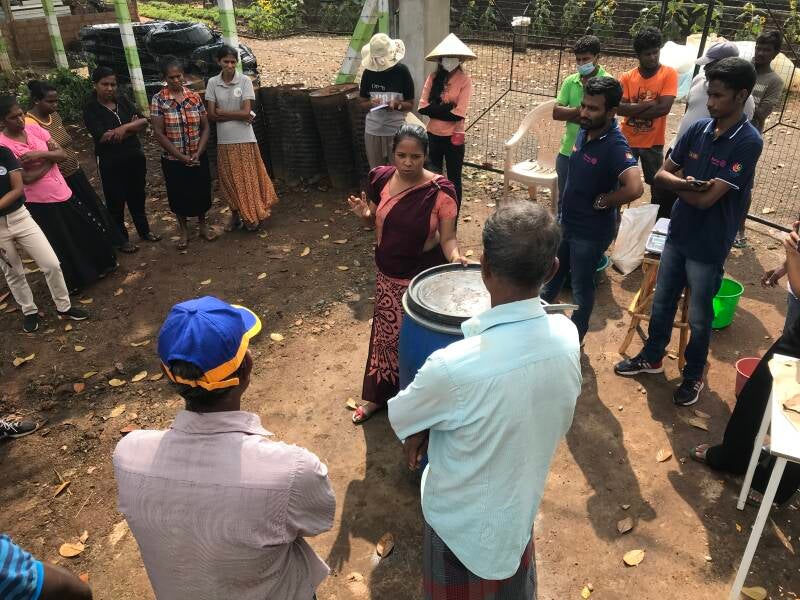
- Capacity Building: I organized training sessions that taught the community to produce various bio-fertilizers, including Fish tonic, Fruit tonic, and 'Jeewa murtham'.
- Sustainable Governance: To ensure the project’s longevity, I established the "Sarubima Agripreneurship Committee," empowering the community to manage production and sales independently.
- Scientific Validation: I initiated quality testing of OLF samples at the Faculty of Agriculture, University of Peradeniya, to provide data-backed assurance to potential buyers.
- Socio-Economic Impact: The project successfully transformed a local community into a self-functioning agripreneurial hub, promoting a sustainable, chemical-free future for the region.
- Knowledge Transfer and Succession: Recognizing that sustainability requires continuity, I systematically transitioned all lessons learned, technical documentation, and stakeholder contacts to the next leadership tenure. This ensured that the project didn't stall during the leadership handover but instead continued to scale with a clear roadmap of previous challenges and successful mitigation strategies.



Project 4: Social-Ecological Modeling for Sustainable Estate Societies: An Intellectual Tourism Framework
Background and Relevance
Building a "Sustainable Society" requires balancing environmental preservation with the socio-economic resilience of its inhabitants. In the plantation sector, communities are often vulnerable to market fluctuations and lack diversified income. This project aimed to design a disruptive social-enterprise model—Intellectual Tourism—to transform high-biodiversity landscapes into knowledge-hubs. By integrating community-led conservation with a non-extractive financial model, the project sought to create a system where biodiversity protection directly fuels community upliftment, moving away from traditional, resource-heavy tourism.
The Skills Involved
- Participatory Data Collection (PRA): Conducted Participatory Rural Appraisals and community-wide surveys to gather qualitative and quantitative data on social needs, local expertise, and labor dynamics.
- System Feasibility & Risk Modeling: Performed a Strategic SWOT Analysis to model the interplay between environmental assets (endemic species) and social risks (human-wildlife conflict, over-reliance on chemical inputs).
- Multi-Stakeholder Architecture: Designed a collaboration framework involving the IUCN, corporate management, and the rural estate workforce to ensure the model was socially inclusive and scientifically rigorous.
- Environmental Data Integration: Synthesized soil and water quality parameters with socio-economic data to validate the ecological carrying capacity of the proposed tourism model.
My Contribution and Outcome
I led the research and design phase of this initiative, focusing on the interface between community livelihoods and ecological stability.
- Data-Driven Decision Making: I analyzed survey data from estate workers and management to identify "knowledge gaps." I proposed bridging these gaps through partnerships that empower local workers to act as "Citizen Scientists" and research guides.
- Economic Model Design: I developed a feasibility roadmap for a biodiversity credit system and intellectual tourism, which minimizes natural resource exploitation while maximizing intellectual value.
- Strategic Roadmap: My work provided the company with a "win-win" framework for business sustainability, addressing critical threats like climate change and invasive species through community-led monitoring.
- Recognition: This project, which bridged the gap between business sustainability and environmental health, was awarded "Best Presenter" at the International Conference on Business Sustainability (ICBS 2024).


Project 5 : National Policy Framework Drafting: Data Integration for the Sri Lanka’s Biodiversity Strategy and action Plan 2026–2030
Background and Relevance
Developing a National Biodiversity Strategy and Action Plan (NBSAP) is a complex challenge in "Sustainable Societies" governance, requiring the alignment of international mandates (CBD, SDGs) with local socio-economic realities. Working with the Centre for Poverty Analysis (CEPA) on a UNDP-facilitated project, I contributed to drafting the national roadmap for 2026–2030. This project is highly relevant as it addresses how a nation can transition toward a nature-positive economy by integrating marginalized voices—such as indigenous communities and gender-diverse groups—into a data-backed policy framework. It tested my ability to work at the intersection of Data Science, Policy, and Social Inclusion
The Skills Involved
- Policy Data Synthesis & R Programming: Leveraged statistical tools (R) to synthesize vast datasets from literature reviews and field reports into actionable policy targets.
- Inclusive Stakeholder Architecture: Facilitated a multi-layered consultation process, including Indigenous Community Consultations, regional workshops for NGOs and government, and specialized Gender and Inclusion sessions to ensure equitable policy design.
- Financial Modeling (Biodiversity Financing Plan): Contributed to the development of a national financing plan in collaboration with the UNDP to identify diverse funding streams for conservation.
- Strategic Drafting: Integrated national conservation actions with global frameworks (e.g., the Kunming-Montreal Global Biodiversity Framework) through rigorous institutional and stakeholder mapping.
My Contribution and Outcome
As a Research Assistant, I served as a bridge between high-level data analysis and community-level insights to ensure the NBSAP was both scientifically robust and socially just.
- Quantifying Qualitative Insights: I took the leads from indigenous and regional consultations and coded them into thematic data points to inform strategic priorities.
- Bridging the Financing Gap: I supported the drafting of a Biodiversity Financing Plan, exploring innovative mechanisms to fund the proposed actions, ensuring that the policy is not just a document but a financially viable reality.
- Systemic Integration: I assisted in the institutional analysis that identified how different government sectors (Private vs. Public) can collaborate on sustainable land use.
- National Impact: My work directly contributes to Sri Lanka’s official submission to the Convention on Biological Diversity (CBD), setting the national standard for conservation and sustainable development for the next decade.


